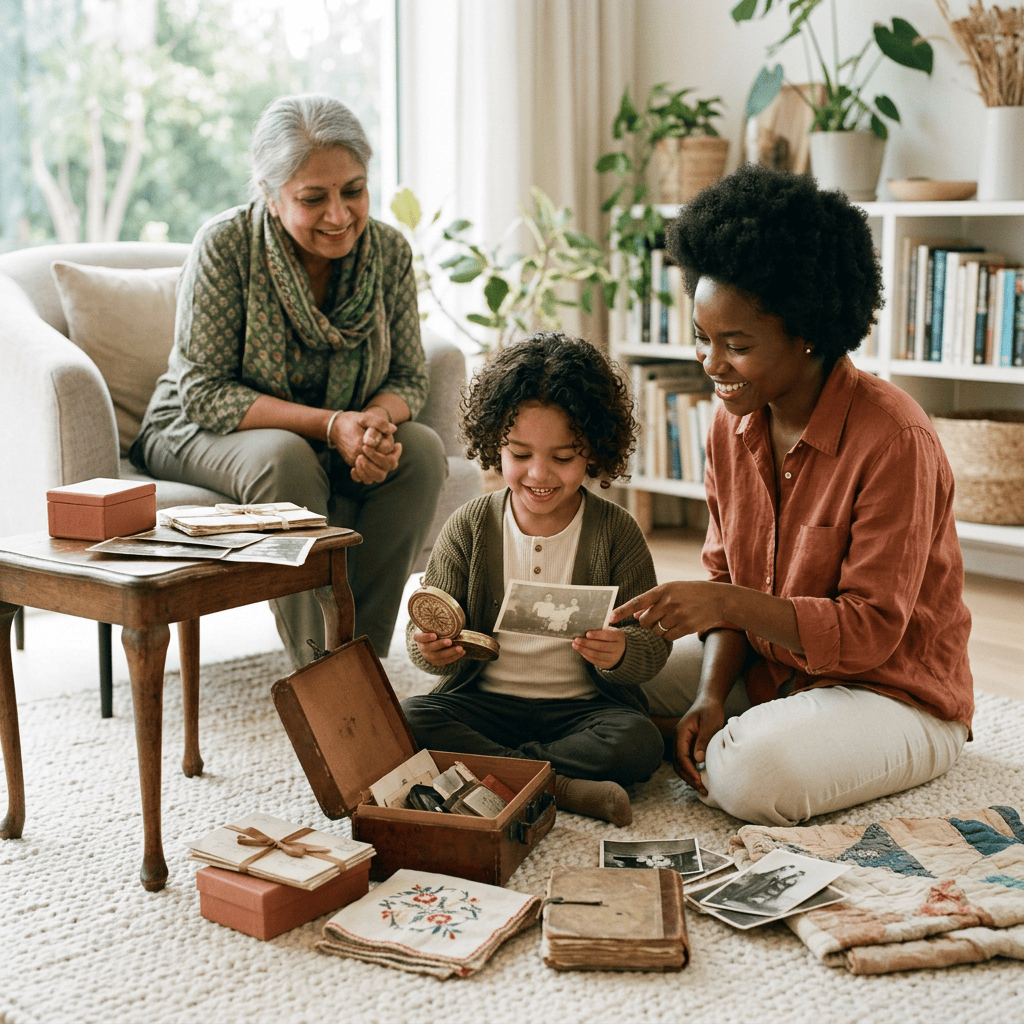
Holding hands on a busy sidewalk, a mother and her young son navigate the afternoon crowd. Suddenly, the boy looks up, his eyes wide with a puzzling new realization. “Mommy,” he exclaims, “I’m not Black or white, I’m mixed up!”
For writer Sa’iyda Shabazz, a Black mother whose son has what he describes as “peach” skin, those words took everything she had not to stop dead in her tracks. Her son was beginning to grapple with a profound question: how could he have grown in her brown belly when his own skin looks so much like his white father’s?
When a multiracial child asks a caregiver, “What am I?”, the query is rarely a simple request for biological or genetic classification. Instead, it represents a critical developmental intersection where the child’s evolving self-concept collides with the rigid, monoracial categories of broader society. Rather than viewing this moment as a source of tension, developmental psychologists and family therapists conceptualize it as a vital opportunity to foster identity integration, resilience, and psychological well-being.
For parents, the goal is not to hand down a single, static racial label. Rather, it is to provide truthful language, a secure sense of belonging, and the emotional room for children to understand and define themselves as they grow.
What the Child is Really Asking
When a multiracial child begins asking about their background, their questions are rarely abstract. Often, they are trying to reconcile their internal feelings of selfhood with the external messages they receive from the world. Underneath the simple question “What am I?”, several deep emotional needs are typically at play:
- The Search for Belonging and Family Connection: Children are highly perceptive of physical differences long before they possess the linguistic or conceptual tools to understand race as a social construct. When a child realizes their skin color, hair texture, or facial features do not “match” one or both of their parents, they may experience anxiety about their place in the family. They are seeking reassurance that family connection is built on love and shared history, not physical identicalness.
- Navigating Cognitive Dissonance: We live in a society built on a “monoracist” paradigm—the assumption that every person can and should belong to only one racial category. For a multiracial child whose very existence transcends these boundaries, the constant societal demand to fit into a single box can create a painful sense of being fragmented or, as Shabazz’s son put it, literally “mixed up”.
- A Need for Safe Validation: Frequently, these questions are triggered by an external encounter—a classmate’s comment on the playground, a box on a school form that permits only one selection, or an intrusive look from a stranger. In these moments, children are asking if they are accepted just as they are, and whether they have permission to embrace all parts of their heritage.
The Crucial Distinction: Self-Identification vs. Perception
A foundational concept for parents to grasp is the distinction between how a child identifies internally (their self-concept) and how others perceive them externally (social categorization).
Empirical research indicates that these two realities do not always align. Society often categorizes children based on immediate physical features or the racial demographics of the parent they are with. However, a child’s internal identity is a highly personal, lived experience that is shaped by family culture, individual attachments, and personal exploration.
For example, a child may be perceived by peers as monoracially Black or white due to their physical appearance, while maintaining a deeply valued, private multiracial identity with family and friends. Understanding this gap helps parents realize that they do not need to “fix” or force an identity label. Your role is to validate their internal sense of self-worth while equipping them to navigate the external perceptions of the world.
Why Parents Must Pause and Listen
When these questions surface, a parent’s immediate reaction sets the emotional tone for how the child will process their identity. It is common for well-meaning caregivers to feel uncomfortable or embarrassed, particularly if a young child loudly points out physical differences in a public space.
An everyday, practical example illustrates how this dynamic plays out in real life: Imagine a young child loudly asking in a store, “Mommy, why is that person’s skin so dark?” An embarrassed parent might instinctively respond with a hushed, sharp “Ssh!” However, developmental research indicates that this reaction sends a powerful, unintended moral cue. The child does not stop noticing physical differences; instead, they learn that race is a shameful, taboo topic that must not be discussed. Experts call this conditioning children to be “color-silent”.
Before jumping in with a pre-scripted answer or a forced, scheduled “big talk”—which child psychiatrists warn can feel unnatural and even semi-traumatic for young minds—parents must pause, check their own insecurities, and listen deeply. Because a monoracial parent will never share the exact lived experience of their multiracial child, they must let the child lead the conversation.
By creating an organic space where curiosity is met with calm, direct reassurance during ordinary routines—like car rides, dinner, or bedtime—parents establish themselves as a trusted source of support.
How to Answer with Truth and Wholeness
When discussing race with your child, professional clinical guidance recommends aiming for “color fairness” rather than “colorblindness”. Adopting the colorblind narrative that “we don’t see color” erases a multiracial child’s daily physical experiences and leaves them completely unprepared for the societal biases they may eventually encounter.
Instead, normalize physical differences factually and warmly. Consider this illustrative example of a simple, objective parent-child response:
Parent: “Everyone’s skin is different, and all skin colors are beautiful. Just like we have different hair colors or eye colors in our family, people have different skin colors too. It’s just part of what makes our world so wonderful and interesting.”
Linguistic reframing is another vital tool for fostering internal wholeness. Well-meaning relatives and parents often describe multiracial children using mathematical fractions, such as “half-Black, half-white” or “one-quarter Japanese”. Clinicians advise strongly against this phrasing. Fractions are reductive; they imply that a child is fragmented into separate, incomplete pieces.
To counter this, parents can use an illustrative script focused on additive conjunctions:
Parent: “You are Black AND Asian. You have two rich, beautiful ancestries, and you are not half of anything.”
Additionally, professional guidelines caution parents to avoid terms that fetishize or objectify multiracial children. While people often intend comments like “mixed kids are the best of both worlds” or “she looks so exotic” as compliments, these words treat children as abnormal curiosities rather than whole human beings. Keep your praise focused on your child’s character, intellect, and unique personal strengths.
Understanding Your Child’s Evolving Journey
Racial identity development is a dynamic, lifelong process that shifts as a child’s cognitive abilities mature. To support them effectively, parents should keep these developmentally appropriate milestones in view:
- Infants (6 to 9 Months): Studies show that babies notice physical differences like skin color and hair texture as early as six months of age. They begin to show familiarity preferences for the skin tones of their primary caregivers.
- Toddlers (Ages 2 to 3): By age two, children point out physical differences out of natural, unbiased curiosity. By age three, they can begin to form social preferences and absorb early environmental attitudes.
- Preschoolers (Ages 4 to 5): Children in this stage transition from pre-color constancy (observing differences but thinking skin color is mutable) to post-color constancy. Once they realize skin tone is a stable, permanent trait, they frequently begin asking why they do not look exactly like their parents. They may also demonstrate internalized biases absorbed from media and peer culture.
- Middle Childhood (Ages 8 to 11): At this stage, children are concrete thinkers who easily grasp concepts of right versus wrong, fair versus unfair. They are increasingly aware of societal labels and how social groups are categorized.
- Adolescence (Ages 12 and up): Teenagers become abstract thinkers capable of navigating sociopolitical issues. Multiracial youth often feel heightened societal pressure to choose or identify with a single racial group, often the group associated with their parent of color.
Because identity is fluid, your child’s self-identification may naturally change over their lifetime. A teenager may embrace their dual heritage in one stage, emphasize a single-race identity in another, or move fluidly depending on their social context.
Contemporary ecological models refer to this situational flexibility as the “chameleon experience”. Shifting behaviors or self-presentation in different social settings is not a sign of confusion or a fractured self; rather, it is a healthy, normal, and highly adaptive capacity that allows multiracial youth to navigate diverse cultural environments with resilience.
When Siblings Do Not “Match”
One of the most complex dynamics within multiracial families occurs when biological siblings inherit markedly different physical features. Due to the genetic lottery of racial mixing, siblings can vary widely in skin color, hair texture, and eye shape. One child may be “white presenting” or “white appearing” (phrasing that respectfully de-centers whiteness), while their sibling is perceived more clearly as a person of color.
These physical differences mean that siblings will encounter very different realities outside the safety of the home. Lighter-skinned siblings may experience less systemic bias but face “light-skin isolation” or have their cultural authenticity questioned, while darker-skinned siblings may encounter profiling or microaggressions. This disparity can generate divided loyalties, jealousy, and colorism within the family.
To foster a secure, supportive home environment, professional guidance recommends that parents actively neutralize the effects of colorism:
- Acknowledge the Disparity Factually: Avoid the harmful strategy of pretending both siblings have the exact same experience. Validate that the world may treat them differently, and ensure they know that the problem lies entirely with societal bias, not with them.
- Strictly Prohibit Qualitative Comparisons: Never compare hair textures or skin tones in ways that assign value. Comments like “she got the good hair” or “he has the nice tan coloring” reinforce historical colorist hierarchies and must be prohibited. Love, celebrate, and affirm each child’s physical traits individually without ranking them.
Navigating Public Situations and Setting Boundaries
Many identity questions are triggered when children experience or witness intrusive comments from strangers or even extended family members. Strangers may look back and forth between a parent and child to figure out if they are related, ask “Are you the nanny?”, or reach out to touch a child’s hair without permission.
Children watch their caregivers closely in these moments to see how they should feel. If a parent reacts with visible shame, anger, or defensiveness, the child can internalize the belief that something is fundamentally “wrong” with them or their family.
Parents must serve as the first line of boundary defense, keeping their reactions calm, confident, and firm. You can model healthy boundaries by practicing natural, supportive comebacks that keep the focus on your child’s humanity rather than satisfying a stranger’s curiosity:
- When asked, “What is she?” or “What is she mixed with?”: Keep it light and focused on character: “She is my daughter, and she is amazing and creative!” or simply state, “She is Black and Japanese.”
- When asked, “Are you her real parent? You don’t match”: Respond warmly: “Yes, she is perfect—don’t you think?” or calmly set a boundary: “I am stunned that you would ask such a personal thing.”
- When a relative makes a colorist remark about skin tone: Intervene immediately: “We love his beautiful brown skin, and we do not make comparisons about skin tones in our home.”
- When someone demands they “choose a side”: Reassure your child in front of them: “They are Black and white. They belong to our entire family, and they never have to choose.”
A Takeaway for Your Home: The Multiracial Bill of Rights
To empower your child to stand strong in their identity, experts recommend actively introducing them to Dr. Maria Root’s Bill of Rights for People of Mixed Heritage. You can print this framework out, read it together, and integrate its tenets into your daily family values.
Teach your children that they have the right:
- Not to keep the heritages separate within themselves.
- Not to be responsible for other people’s discomfort with their physical ambiguity.
- To identify themselves differently than strangers, parents, or siblings expect.
- To identify themselves differently in different situations without feeling like they are being fake or disloyal.
- To change how they identify over their lifetime—and more than once.
By explicitly validating these rights, you give your child a sturdy psychological shield against a world that will try to box them in.
Keeping the Conversations Going
Nurturing a healthy multiracial identity is a marathon, not a sprint. Beyond having talks, focus on cultural exposure and lived family culture.
Ensure your home is filled with “mirrors”—diverse toys, multicultural books, artwork, and media that depict families like yours doing ordinary, joyful things. Blending your heritages to create unique family traditions—such as celebrating hybrid holidays or fusing traditional cuisines at dinner—teaches children that they never have to choose between the people they love.
Talk about your family’s genealogy, share the stories of ancestors who faced and overcame challenges, and build connections with other multiracial families. When your child sees that their background is an enriching, valued, and normal part of your family’s daily life, they learn to view their identity with deep pride.
A child who asks, “What am I?” is asking for far more than a simple category. They are asking if every part of their heritage, their family, and their physical self belongs. Your role as a parent is not to decide their final label for them, but to equip them with history, language, unconditional love, and the ultimate freedom to grow into their own beautiful answer.
Research Sources and Further Reading
1. Sa’iyda Shabazz
- Author or Organization: Sa’iyda Shabazz
- Title: “Talking To My Young Son About Being Mixed Race Is Never Simple”
- Publication or Website: Scary Mommy
- Publication Date: Updated March 6, 2020
- URL: https://www.scarymommy.com/mixed-race-kids-important-conversation
- Contribution: Contributed the opening real-life narrative of a Black mother walking with her son, who exclaims he is “mixed up”, illustrating the cognitive and emotional struggles of young multiracial children.
2. Jamie Weaver and Azadeh Masalehdan Block, Ph.D.
- Author or Organization: Jamie Weaver and Azadeh Masalehdan Block, Ph.D.
- Title: “Identity Development in Biracial Children: Contextual Factors from Social Work”
- Publication or Website: Keystone Journal of Undergraduate Research
- Publication Date: 2020
- URL: https://www.ship.edu/globalassets/keystone-journal-archive/v7n1_weaver_masalehdan.pdf
- Contribution: Provided the academic foundation on “border identity”, showing that identifying with multiple heritages leads to higher well-being, lower stress, and higher self-esteem than forced monoracial categorization.
3. Professional Guidance White Paper
- Author or Organization: Not provided in the source
- Title: “Clinical and Developmental Frameworks for Supporting Multiracial Children: Fostering Identity Integration, Navigating Societal Pressures, and Optimizing Family Systems”
- Publication or Website: Not provided in the source
- Publication Date: 2026 (citing recent copyright years)
- URL: Not provided in the source
- Contribution: Contributed the clinical concept of the “monoracist paradigm” and analyzed the psychological damage of color silence and the benefits of practicing color fairness.
4. Amylia Ryan (featuring Dr. Beverly Daniel Tatum)
- Author or Organization: Amylia Ryan (featuring Dr. Beverly Daniel Tatum)
- Title: “How to Talk to Your Toddler About Race”
- Publication or Website: Babylist
- Publication Date: Updated On Apr 29, 2026
- URL: https://www.babylist.com/hello-baby/talking-about-race-toddler
- Contribution: Provided the developmental timelines of infantile physical awareness and supported the clinical framework of “color fairness” over colorblindness.
5. Dr. Sheila Modir
- Author or Organization: Dr. Sheila Modir
- Title: “Talking to children about race and racism: An age-by-age guide”
- Publication or Website: CHOC Health (Children’s Hospital of Orange County)
- Publication Date: January 17, 2022
- URL: https://health.choc.org/talking-to-children-about-race-and-racism-an-age-by-age-guide/
- Contribution: Provided the age-appropriate developmental guidance for middle childhood and adolescence, outlining when children become concrete and abstract thinkers.
6. Dr. Maria P. P. Root, PhD
- Author or Organization: Dr. Maria P. P. Root, PhD
- Title: “Bill of Rights for People of Mixed Heritage” (also published as “Bill of Rights for Racially Mixed People”)
- Publication or Website: LITERANISTA / Columns (University of Washington alumni magazine) / Project Race
- Publication Date: Originally formulated in the 1990s (Columns publication December 1996; LITERANISTA blog October 2, 2009)
- URL: https://www.valeriemevans.com/uncategorized/bill-of-rights-for-people-of-mixed/ (or https://www.washington.edu/alumni/columns/dec96/blurring5.html or https://www.apa.org/pubs/videos/4310742-rights.pdf)
- Contribution: Provided the landmark “Bill of Rights for People of Mixed Heritage,” which serves as the ultimate parental tool to validate a child’s right to self-identify fluidly, navigate situational settings, and resist being boxed in.
7. Laura Wheatman Hill (featuring Dr. Pascale Chrisphonte, MD)
- Author or Organization: Laura Wheatman Hill (featuring Dr. Pascale Chrisphonte, MD)
- Title: “Discussing Race In A Biracial Family” (URL title: “How To Talk About Race With Your Biracial Child”)
- Publication or Website: The Well by Northwell (Northwell Health)
- Publication Date: May 2, 2022
- URL: https://thewell.northwell.edu/parenting/biracial-child-talk-race
- Contribution: Contributed the crucial child-led approach to talking about race, advising parents to use organic everyday moments instead of scheduled “big talks” which can be semi-traumatic.
8. Jennifer Noble, PhD
- Author or Organization: Jennifer Noble, PhD
- Title: “How to respectfully describe mixed race kids”
- Publication or Website: Free to Be Collective (formerly drjennpsych.com)
- Publication Date: January 16, 2025 (Copyright year 2025)
- URL: https://freetobecollective.com/blog/how-to-respectfully-describe-mixed-race-kids
- Contribution: Provided key clinical directives on using the additive conjunction “and” instead of reductive mathematical fractions and using the term “white presenting” instead of “passing”.
9. Jeanne Phillips
- Author or Organization: Jeanne Phillips
- Title: “Dear Abby: How to shut respond to comments about biracial child” (or “How to respond to comments about biracial child”)
- Publication or Website: SFGATE (Hearst Communications)
- Publication Date: Updated June 8, 2015
- URL: https://www.sfgate.com/entertainment/article/Dear-Abby-How-to-shut-respond-to-comments-about-6313974.php
- Contribution: Offered the insight that children closely mirror their caregivers’ reactions during public microaggressions; responding with immediate confidence and warmth prevents children from feeling personal shame.
10. Lori L. Tharps
- Author or Organization: Lori L. Tharps
- Title: “Same Family, Different Colors: Talking Colorism in the Family”
- Publication or Website: EmbraceRace
- Publication Date: 2020 (Webinar transcript, site copyright 2026)
- URL: https://www.embracerace.org/resources/same-family-different-colors-talking-colorism-in-the-family
- Contribution: Provided the analysis of intra-familial colorism and the concrete practices parents can employ to neutralize qualitative comparisons of skin tone and hair texture between multihued siblings.
11. Sonia Smith-Kang
- Author or Organization: Sonia Smith-Kang
- Title: “How To Talk To Your Mixed Race Kids About Race”
- Publication or Website: The Mash-Up Americans
- Publication Date: Not provided in the source (Refers to 1980s youth)
- URL: https://www.mashupamericans.com/talk-mixed-race-kids-race/
- Contribution: Contributed parenting insights on preparing kids for microaggressions and validating their right to be whole people who are not responsible for others’ discomfort.
12. Wikipedia Contributors
- Author or Organization: Wikipedia contributors
- Title: “Biracial and multiracial identity development”
- Publication or Website: Wikipedia, The Free Encyclopedia
- Publication Date: Last edited 3 February 2026
- URL: https://en.wikipedia.org/wiki/Biracial_and_multiracial_identity_development
• • Contribution: Provided a comparative overview of foundational stage theories of biracial development (Poston, Kich, Jacobs) and defined the “chameleon experience” (situational identity) as a healthy, adaptive capacity.


Leave a comment