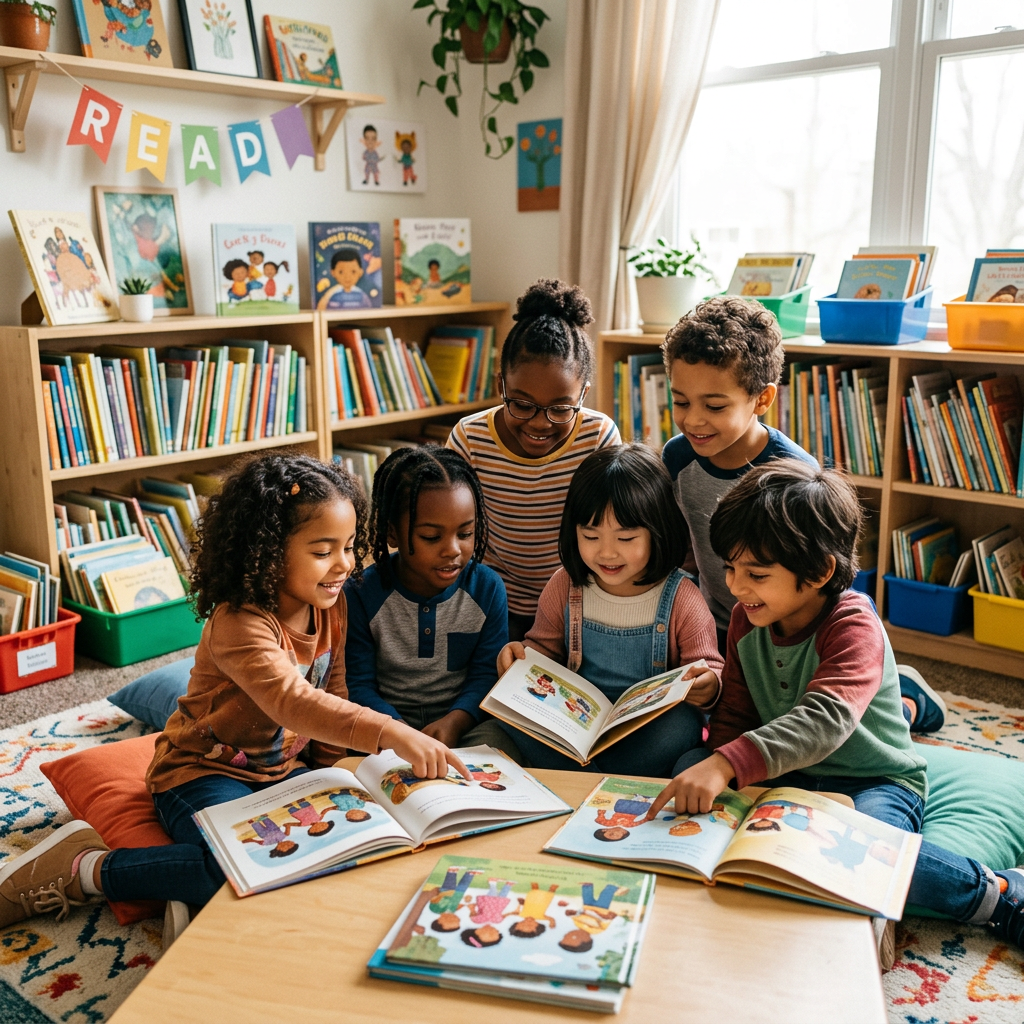
The demographic landscape of our communities is undergoing a rapid transformation. Children of multiple heritages represent one of the fastest-growing youth segments in the United States, a community projected to triple in size to over 26 million individuals by 2060. Across our classrooms, libraries, and family tables, multiracial and multicultural youth are living lives shaped by a rich blend of cultures, languages, and histories. Yet, bicultural protagonists have historically made up less than one percent of the children’s book market, leaving a vast systemic void.
To understand why this gap matters so deeply, we must look to the pioneering work of children’s literature scholar Dr. Rudine Sims Bishop, who in 1990 introduced the foundational metaphor of books as “mirrors, windows, and sliding glass doors”. Bishop explained that under the right conditions, a window can also be a mirror, reflecting a reader’s own life back to them as a vital form of self-affirmation. Seeing oneself reflected in a story validates a child’s experiences, communicating that their life, family, and heritage are valued and important. But books must also be windows, offering a view into worlds different from our own. For children from dominant groups who always find their mirrors in books, window books are a crucial necessity to prevent developing what Bishop described as an “exaggerated sense of their own self-worth” and a distorted, mono-cultural view of a diverse world.
1. The Scaffolding of Self: Identity Synthesis and the Power of “Mirrors”
For multiracial youth, the development of a healthy identity is an active, interactive process. Early childhood specialists suggest that the years between preschool and early elementary school (ages three to eight) are the most critical developmental stages for facilitating a positive racial and ethnic identity. During this window, children actively absorb messages from their families, peers, and media about who they are and where they belong.
Historically, psychological research operated under the pathologizing assumption that multiracial individuals were inherently prone to identity confusion, low self-esteem, and social isolation. Today, modern developmental psychology has thoroughly dismantled this deficit lens. Research shows that multiracial children do not differ from their monoracial peers in self-esteem, emotional adjustment, or self-comfort; instead, they demonstrate high academic achievement, a resilient self-concept, and a uniquely high tolerance for social diversity.
Crucial to this healthy development is what researchers call a “border identity”—a multidimensional model of biracial identity wherein children are validated in embracing all aspects of their ancestral lineages as a unified whole, rather than being forced to choose a single, monoracial category. Sociological studies indicate that youth who successfully adopt an integrated multiracial identity experience higher levels of emotional well-being, lower levels of stress and alienation, and greater overall life satisfaction.
Classrooms and libraries play a massive role in this socialization process. Tatum’s research has shown that when schools fail to properly celebrate diverse and multiracial heritages, children are left to navigate unresolved racial identity conflicts alone, which can lead to academic disengagement and a decreased sense of school belonging. Conversely, when a child’s rich heritage is actively validated on the page and in the classroom, it provides the psychological scaffolding they need to step into the world with confidence and pride.
2. Dismantling the “Tragic Mulatto”: Moving Middle-Grade Literature from Deficit to Agency
As children enter late childhood and early adolescence (ages nine to fourteen), their cognitive development matures, allowing them to engage with more complex, abstract social realities. At this stage, middle-grade novels featuring multiracial protagonists serve as essential tools for navigating identity, but much of the realistic fiction published for this age group has historically relied on pathologizing, deficit models of mixed-heritage life.
In their landmark 2013 content analysis of 90 middle-grade realistic novels featuring bicultural characters, researchers Dr. Amina Chaudhri and Dr. William H. Teale discovered that stories fell into three distinct narrative trends:
- Mixed Race In/Visibility (MRI/V) (34% of novels): In these books, a character’s biracial identity is framed as an inherent “problem” and the primary source of conflict. These stories often rely on the centuries-old “tragic mulatto” trope, representing characters who experience low self-esteem, self-hatred, and complete social isolation solely because they are mixed. The environment is typically homogeneous, and any structural critique of racism is completely missing—the trauma is located entirely within the child’s identity.
- Mixed Race Blending (MRB) (34% of novels): In these books, a protagonist’s mixed heritage is merely descriptive rather than functional. While these books avoid harmful stereotypes, heritage is treated as tangential to the plot. These “melting pot” stories are useful for normalizing diverse faces, but they often subscribe to a “colorblind” ideology that ignores the specific, rich cultural heritages multiracial individuals inherit.
- Mixed Race Awareness (MRA) (31% of novels): This is the ideal model for identity-affirming literature. In MRA stories, characters recognize their heritages, negotiate bicultural backgrounds in complex ways, and resolve conflicts with believable self-confidence and secure, resilient self-images. These characters emerge from painful experiences emotionally intact, supported by loving families, educators, and peers.
Parents, librarians, and educators should actively seek out Mixed Race Awareness novels. We can see this affirming, agency-centered model in several exemplary middle-grade works:
- Sharon M. Draper’s Blended: Eleven-year-old Isabella Thornton splits her time weekly between her white mother’s working-class home (where she is “Izzy”) and her wealthy Black father’s residence (where she is “Isabella”). Draper bypasses the tired, sugarcoated trope of the “two Christmases” to lay bare the exhaustion of living out of a suitcase and navigating two contrasting socio-cultural environments. The novel confronts real-world systemic racism and police profiling, modeling how a young girl learns to refuse the pressure to “choose a side,” ultimately declaring her bicultural wholeness.
- Veera Hiranandani’s The Whole Story of Half a Girl: Sonia Nadhamuni, a half-Indian and half-Jewish American sixth-grader, is forced to transition from a progressive private school to a public middle school after her father loses his job. At her new school, Sonia is suddenly confronted with rigid racial boundaries, forcing her to negotiate her identity for the first time. Sonia’s journey is a quiet, emotionally honest, and realistic exploration of adolescent belonging. Hiranandani handles sensitive family issues—including her father’s clinical depression—with care and nuance, demonstrating that a dual heritage is a source of strength, not a deficit.
- Marilyn Hilton’s Full Cicada Moon: Set in 1969 Vermont against the backdrop of the Apollo 11 moon landing, this novel-in-verse follows thirteen-year-old Mimi Yoshiko Oliver, the daughter of an African-American father and a Japanese mother. Facing double prejudices of race and gender, Mimi utilizes active agency to pursue her STEM dreams, entering science competitions and fighting to take a woodshop class instead of home economics. Hilton’s spare verse and repeating motif of “drip, drip, drip” remind readers that “raindrops are stronger than hammers,” illustrating how a girl can confidently stand up for herself and reshape her homogeneous community.
3. The Danger of “Casual Diversity” and the Non-Human “Distance Trap”
As we audit classroom and home libraries, we must look critically at the rise of “casual diversity”. In her content analysis of bicultural picture books, researcher Kiana Foster-Mauro discovered that 84% of the analyzed books featuring multiracial characters provided no specific cultural information. These books belong to what Bishop termed the culturally “generic” category. While useful for showing diverse faces participating in universal, everyday activities, an over-reliance on culturally generic books can result in a library that erases the rich, specific details of a child’s actual heritage.
Furthermore, publishers frequently rely on non-human allegories to introduce multicultural themes to very young children. We see this in popular books like Tania Duprey Stehlik’s Violet (featuring a purple child born to a blue dad and a red mom) or Kyo Maclear’s Spork (featuring a hybrid utensil who sighs that “it must be easier to be a single thing”).
While these allegories are accessible, children’s literature experts warn that they create a dangerous “distance trap”. Representing multicultural children as inanimate utensils, shapes, or mixed-breed animals (such as a “puggle” in Christian Trimmer’s What Are You?) can inadvertently reinforce the problematic idea that mixed-race individuals are exotic, engineered, or fundamentally distinct from natural human categories. By keeping the conversation at a safe, allegorical distance, these books miss the opportunity to validate actual, human lived experiences.
4. Sibling Variation, Food Metaphors, and Aesthetic Friction: Visual Realities in Picture Books
Respectful representation is not just a matter of textual plotting; in literature for young children, illustrations and visual aesthetics carry immense weight. Authentic picture books must accurately capture the physical realities of multiracial and multicultural families.
One persistent visual gap is the flattening of phenotypic diversity within a single family. In real life, bicultural siblings and twins often express a wide genetic spectrum of skin tones, hair textures, and physical traits. Yet, children’s illustrators frequently “flatten” these differences into uniform skin shades.
A poignant example of this visual friction occurred in the critical reception of The Case for Loving: The Fight for Interracial Marriage by Selina Alko and Sean Qualls. While highly praised for making the historic Loving v. Virginia Supreme Court case accessible to young readers, the book faced criticism for its depiction of the three Loving children. Historically, the Loving siblings displayed different physical traits: the oldest son, Sidney, had Afro-multiracial features and a dark complexion; Donald was light olive-toned with straight dark hair; and Peggy was fair-skinned with straight blonde hair and blue eyes. However, the illustrators rendered Donald uniformly brown and described all three children as “three different shades of milk chocolate brown”. By flattening these sibling phenotypes, the book missed a vital opportunity to validate bicultural mixed-race children who are overlooked because they do not look “brown enough” to fit conventional expectations of a multiracial person.
Furthermore, parents and educators should cast a critical eye on the overuse of objectifying food metaphors. Far too many children’s books over-rely on describing darker skin tones as “chocolate,” “caramel,” “cinnamon,” or “peanut butter”. Because white skin is rarely described through food analogies (such as “creamy mayonnaise”), overusing these metaphors for children of color can feel clichéd, objectifying, and exoticizing [SOURCE NEEDED]. Instead, look for books like Monique Fields’ Honeysmoke, which centers on a multiracial girl who rejects outside labels to actively construct her own self-defined vocabulary for her skin tone, illustrating that children themselves hold the inner wisdom to define their identity.
5. Embracing Wholeness: The “Not One or the Other, But Both” Paradigm
The ultimate goal of inclusive literature is to celebrate identity synthesis—the beautiful reality that multiple heritages can coexist in a single, whole identity. We must reject narratives that frame biculturalism as a tragedy, and instead highlight books that present a multi-ethnic heritage as a rich, double blessing.
We see this celebratory wholeness in several classic and contemporary picture books:
- Alma Flor Ada’s I Love Saturdays y domingos: A young girl spends Saturdays with her English-speaking, European-American grandparents, and Sundays (los domingos) with her Spanish-speaking, Mexican-American grandparents. Rather than presenting her dual life as fragmented, the narrative frames it as a rich, double blessing. The book seamlessly weaves in Spanish vocabulary and cultural traditions, culminating in a joyful, combined birthday party.
- Monica Brown’s Marisol McDonald Doesn’t Match / no combina: Marisol is a Peruvian-Scottish-American girl with carrot-red hair and brown skin who loves to wear mismatched clothes and eat peanut butter-and-jelly burritos. Despite peer pressure to conform, Marisol unapologetically celebrates her unique self. When her teacher mispronounces her name, Marisol stands her ground, and her teacher later leaves her a heartwarming note validating her. The bilingual format enriches language exposure while reinforcing self-acceptance.
- Dr. Lynnette Mawhinney’s Lulu the One and Only: Written by a biracial scholar, this award-winning picture book tackles the common, invasive question, “What are you?”. Guided by her older brother Zane, Lulu comes up with her own self-defined “power phrase” to declare her identity: “I’m Lulu Lovington, the ONE and only!”. Lulu’s story is a pitch-perfect resource that equips young readers with concrete verbal coping mechanisms to claim their agency on their own terms.
6. Active Facilitation: Moving Beyond the Page with Critical Literacy (Practical Guide for Adults)
Simply placing diverse books on a shelf is not enough. Cognitive and social growth are maximized when adults transition from passive readers to active facilitators. To guide children toward a healthy, resilient self-concept, educators, librarians, and parents can employ three strategic anti-bias practices:
A. Practice the “Whole Book Approach”
Developed by scholar Megan Dowd Lambert, this dialogic reading framework shifts storytime from a passive “performance” to an active “book discussion”. Instead of demanding silence, invite children to read the illustrations, design, and cover art. Engage their critical thinking by using three core open-ended prompts:
- “What do you see happening in this picture?” (Grounds the child in visual evidence).
- “What do you see that makes you say that?” (Asks the child to justify their thinking with evidence).
- “What else can we find?” (Invites the child to lean in, dig deeper, and co-construct meaning).
B. Analyze Power Dynamics and Social Structures
Using Lissa Paul’s critical literacy framework, parents and educators can ask guided questions to help children notice how books reflect, reinforce, or challenge real-world social structures. During your next reading session, try asking:
- “Whose story is this? Who is at the center, and who has been pushed to the margins?”
- “Who has the power or the wisdom in this story, and how do they use it?”
- “Who is named in this book, and who remains nameless?”
- “Who gets punished, and who gets praised?”
C. Voice Your Own Resistance and “Read Against” Biases
You do not need to throw away flawed books. In fact, biased books can be powerful pedagogical tools to teach children about stereotyping and historical erasure. When you encounter a stereotype or a flat representation, model critical reading by sharing your honest reaction aloud: “Wow, this picture really upsets me. I don’t like how this book treats these characters.”. Voicing your resistance teaches children that books are cultural artifacts reflecting specific values, arming them with the mental “antidotes” they need to recognize and resist prejudice in their everyday lives.
7. Conclusion: Interrupting the Silence
Children’s books are far more than simple bedtime stories; they are cultural blueprints through which the next generation learns who matters, who is visible, and who is allowed to belong. For bicultural and multiracial children, seeing their lives reflected in literature with authenticity, complexity, and joy is a developmental necessity.
To build a truly inclusive, pluralistic society, we must support #OwnVoices creators—multicultural and multiracial authors and illustrators whose lived experiences bring rich cultural nuances to the page. By combining library audits, thoughtful book collections, and active reading, parents, teachers, and librarians can build a resilient sense of belonging in every child. Let us interrupt the silence and ensure that every young reader knows they are whole, exactly as they are.
Research Sources and Further Reading
The following verified list compiles only the sources that were directly utilized and quoted to write this article:
- Bishop, R. S. (1990). “Mirrors, Windows, and Sliding Glass Doors.” Perspectives: Choosing and Using Books for the Classroom, 6(3). (Reflected in Bishop’s foundational frameworks throughout).
- Chaudhri, A., & Teale, W. H. (2013). “Stories of Multiracial Experiences in Literature for Children, Ages 9–14.” Children’s Literature in Education, 44(4), 359-376. (Directly utilized for the content analysis on MRI/V, MRB, and MRA narrative trends).
- Draper, S. M. (2018). Blended. New York: Atheneum Books for Young Readers. (Centered in the Section 2 analysis of socioeconomic and police-profiling themes).
- Fields, M. (2019). Honeysmoke: A Story of Finding Your Color. Illustrated by Yesenia Moises. New York: Imprint. (Analyzed in Section 4 for self-defined color vocabulary).
- Foster-Mauro, K. K. A. (2020). Mirrors of Our Own: Multiracial Representation in Children’s Picture Books. University of Connecticut Honors Scholar Theses. (Directly utilized for the 84% “generic/casual diversity” statistical analysis and the non-human allegory critique).
- Hiranandani, V. (2012). The Whole Story of Half a Girl. New York: Delacorte Press. (Analyzed in Section 2 for quiet, introspective identity development and family mental health).
- Hilton, M. (2015). Full Cicada Moon. New York: Dial Books for Young Readers. (Centered in Section 2 for the analysis of Mimi Yoshiko Oliver’s STEM dreams in 1969 Vermont).
- Lambert, M. D. (2015). Reading Picture Books with Children: How to Use the Whole Book Approach for Storytime. Charlesbridge. (Adapted in Section 6 for the dialogic reading guide).
- Mawhinney, L. (2020). Lulu the One and Only. Illustrated by Jennie Poh. Magination Press. (Utilized in Section 5 as an exemplary model for verbal coping strategies and self-defined power phrases).
- Say, A. (2013). The Favorite Daughter. New York: Arthur A. Levine Books. (Analyzed in Section 5 for processing peer-teasing and name reclaiming).
- Tatum, B. D. (1997). “Why Are All the Black Kids Sitting Together in the Cafeteria?” and Other Conversations About Race. New York: Basic Books. (Directly cited in Section 1 for the correlation between school-curriculum validation and academic belonging).
• 12. Weaver, J., & Block, A. M. (2020). “Identity Development in Biracial Children: Contextual Factors from Social Work.” Keystone Journal of Undergraduate Research, 7(1), 13-22. (Grounded Section 1’s developmental psychology, Erikson’s fifth stage, and Rockquemore & Brunsma’s border identity models).


Leave a Reply